Standing water in your yard isn't just an eyesore — it's a sign something's wrong underground. Here's what a French drain actually does about it.
Share:
Summary:
Every spring in Warren County, the same thing happens. The snow melts off the mountains, the ground is still half-frozen underneath, and suddenly your yard is holding water it has no idea what to do with. Some spots stay wet for weeks. The grass dies. The kids and the dog can’t use the yard. And if the water’s pooling anywhere near your foundation, it stops being an inconvenience and starts being a real problem.
A French drain is often the right fix — but only when it’s installed correctly. We’ve been installing these systems across Warren County since 1997, and we’ve learned exactly what works and what doesn’t in this terrain. This guide covers how these systems actually work, what the installation process looks like, and what to watch out for if yours stops doing its job.
At its core, a French drain is a gravel-filled trench with a perforated pipe running through it. Water enters the trench from the surrounding soil, moves through the gravel, flows into the pipe, and gets carried downhill to a safe outlet — a drainage ditch, a dry well, or a lower area of your property away from anything important.
That’s the simple version. The reason it works is that it intercepts water before it can pool on the surface or build up pressure against your foundation. Instead of waiting for water to become a problem, the drain catches it while it’s still underground and moving.
What makes French drains effective for yard drainage specifically is that they handle both surface water and subsurface groundwater. If your yard is low-lying, sits at the bottom of a slope, or just has soil that doesn’t drain well on its own, a properly designed French drain system can change how your property behaves entirely.
Warren County’s terrain isn’t forgiving when it comes to drainage. In the valley floors and developed areas around Queensbury, Warrensburg, and Glens Falls, you’re often dealing with clay-heavy soil. Clay holds water. It drains slowly, it compacts easily, and it doesn’t give water anywhere to go on its own. That’s why yards in this area stay wet long after the rain stops — the soil itself is part of the problem.
Up on higher ground, the challenge flips. A lot of properties in the Thurman and Stony Creek areas have thin soil sitting over rocky ledge. You can’t always dig as deep as you’d like, and water that can’t percolate down tends to run sideways along the surface instead. That creates its own set of drainage headaches.
Then there’s the snowmelt factor. Warren County gets real winters. When several feet of mountain snowpack melts over a few weeks in March and April, it doesn’t just trickle into the ground — it saturates it all at once. Yards that drain fine in July can turn into standing water situations in early spring, and that’s when most homeowners start looking for a permanent solution.
The reason this matters for French drain installation is that the soil type directly affects how the system needs to be designed. Clay soil requires more careful attention to the geotextile filter fabric that wraps the gravel bed — because clay particles are small enough to migrate through low-quality fabric and slowly clog the system from the inside out. Rocky terrain affects how deep we can go and what equipment is needed to get there. These aren’t details you figure out from a YouTube video. They’re the kind of things we’ve learned from years of working the same ground.
We’ve been working in this terrain since 1997, first as a logging operation and then as a full excavation contractor. We know how Warren County clay behaves, where the ledge tends to show up, and how to design a drainage system that holds up through mud season year after year.
A French drain that’s stopped working usually has one of a few things going on. The most common cause is sediment infiltration — fine soil particles, especially from clay-heavy ground, slowly migrate through the gravel bed and pack into the perforated pipe over time. Once enough material accumulates, water can’t move through the system the way it should, and you start seeing the same pooling problems you thought you’d solved.
Tree roots are another major culprit. Roots follow moisture, and a French drain is essentially a long, wet corridor running through your yard. If the drain was installed too close to large trees, roots will find their way in through the pipe perforations and eventually block flow entirely. This is one reason we’re careful about outlet and trench placement relative to any mature trees on a property.
A French drain blocked by sediment can sometimes be cleared with hydro jetting or a drain snake, depending on how far the clog has progressed. If the system has cleanout access points — which any properly installed drain should have — that work is straightforward and doesn’t require digging up the yard. If there are no cleanouts, or if the blockage is severe enough that clearing won’t hold, partial or full replacement may be the better call.
The harder truth is that most premature French drain failures trace back to the original installation. Wrong gravel type, missing or inadequate filter fabric, insufficient slope — these aren’t things that show up as problems right away. They show up two or three years later when the system quietly stops working and you’re back to a soggy yard. Getting the installation right from the start is the only real way to avoid it.
Want live answers?
Connect with a Emerson Excavating and Trucking expert for fast, friendly support.
The installation process starts well before any digging. A proper site assessment looks at where water is entering the yard, how the terrain slopes, what the soil composition is, and where the drain can safely outlet. In Warren County, that also means checking proximity to wetlands, streams, or any regulated areas within the Lake George or Hudson River watersheds — drainage work near those features may require permits, and that’s something we handle as part of the project.
Once the design is set, the trench is excavated — typically 12 to 18 inches wide and 18 to 24 inches deep, depending on the application. The slope has to be consistent from one end to the other, maintaining at least a 1% grade so water keeps moving toward the outlet. That sounds simple, but getting it right across a long trench in uneven terrain takes real equipment and experience.
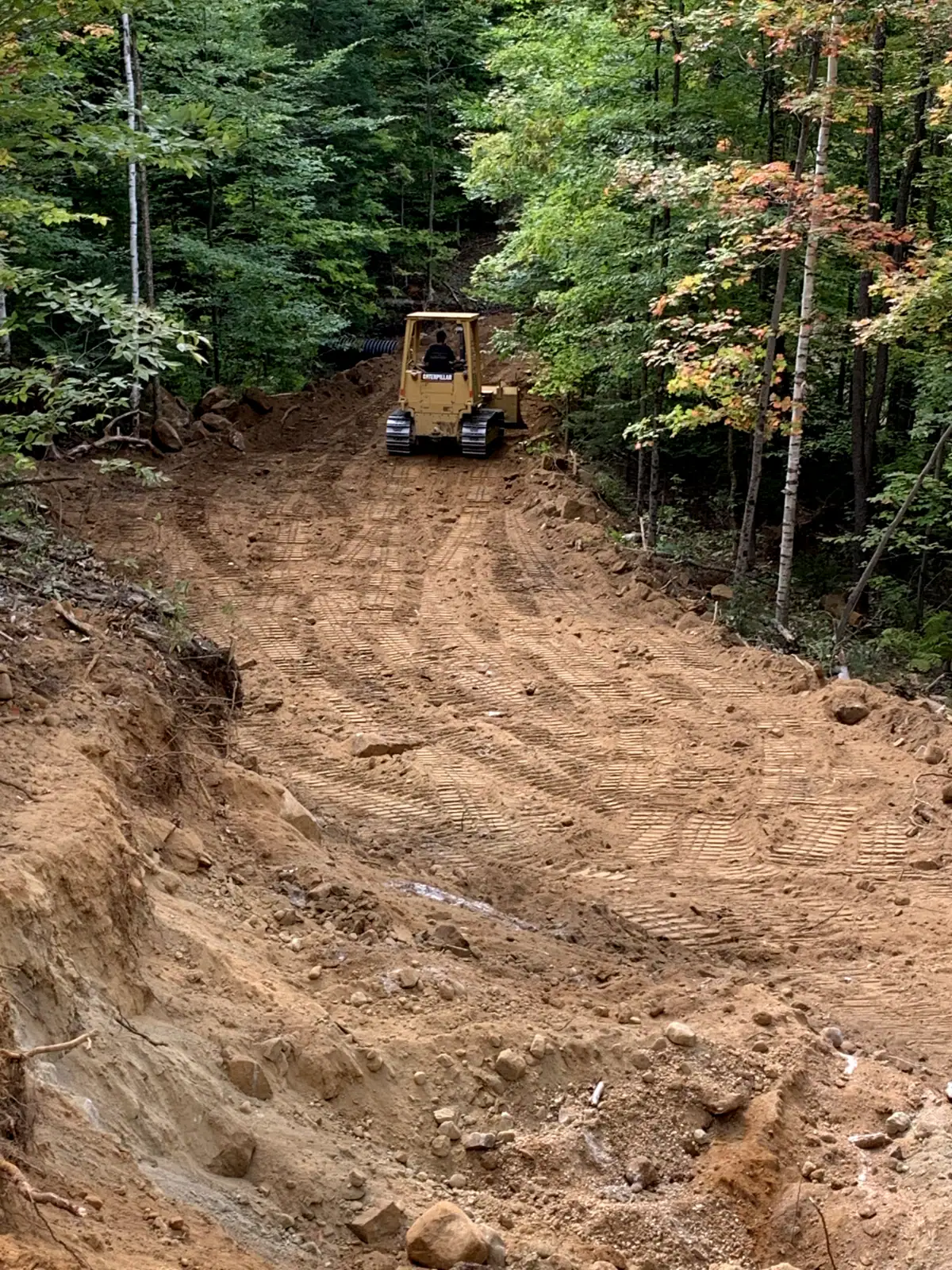
The materials matter more than most people realize. The gravel needs to be angular crushed stone — typically three-quarter inch to one inch — not rounded pea gravel or sand. Angular stone creates air pockets that water can move through freely. Rounded stone and sand compact over time and restrict flow. It’s a small detail that has a big impact on how long the system performs.
The geotextile filter fabric is arguably the most important component. It lines the trench walls and bottom before the gravel goes in, then wraps over the top of the gravel once the trench is filled. Its job is to keep soil particles out of the gravel bed while still allowing water to pass through. In clay-heavy Warren County soils, using the right grade of non-woven fabric — and installing it properly — is the difference between a system that lasts decades and one that clogs prematurely.
The perforated pipe sits in the center of the gravel bed, holes facing down, and carries water from one end of the system to the outlet. Cleanout access points should be installed at both ends of the run, and at midstream intervals on longer systems. These let you flush the drain with a garden hose annually and inspect for buildup without ever having to excavate.
When we oversee an installation, every one of these details gets checked — slope, fabric grade, gravel type, cleanout placement, outlet location. It’s not a checklist exercise. It’s what we do when we’re building something meant to last and we’re going to be the ones people call if it doesn’t.
**How much does it cost to install a French drain?** For an outdoor yard drain, professional installation typically runs $10 to $65 per linear foot. A 100-foot system usually lands somewhere between $1,000 and $6,500, depending on depth, soil conditions, and outlet complexity. Warren County’s clay soil and occasional rocky ledge can affect the excavation side of that cost, which is why a site assessment before quoting is important. What you spend on a properly installed system is almost always less than what you’d spend fixing a failed one.
**Do I need a permit to install a French drain in Warren County, NY?** It depends on where your property is and where the water will be directed. In Queensbury, which is a designated MS4 municipality, stormwater management is actively regulated. Properties near wetlands, streams, or within the Lake George or Hudson River watersheds may require review or permits under New York State DEC or Adirondack Park Agency guidelines. We research permit requirements before any project starts and handle the application process — so you don’t have to figure that out on your own.
**Can I install a French drain myself?** Technically, yes. For a small, simple project on flat ground with easy soil, a motivated homeowner can make it work. But the most common DIY mistakes — wrong slope, wrong gravel, missing or inadequate fabric — don’t show up as failures immediately. They show up a few years later when the drain stops working and you’re looking at excavating the yard again. The cost of redoing a failed DIY install usually exceeds what professional installation would have cost upfront.
**How long does a French drain last?** A properly installed system with the right materials can last 20 to 40 years. Annual flushing from the high end of the drain with a garden hose, and a periodic inspection every year or two, will keep it performing well across that entire lifespan.
**What’s the difference between a French drain and a trench drain?** A trench drain (also called a channel drain) captures surface water at a specific point — like a driveway or patio edge — and carries it away. A French drain works below the surface, intercepting groundwater and subsurface flow before it reaches the surface. Many properties in Warren County need both, depending on where the water is coming from and how your yard slopes.
A French drain is one of the most effective long-term solutions for a yard that won’t stop holding water. But it only works as advertised when the slope is right, the materials are right, and the installation is done by someone who actually knows the ground they’re working with.
In Warren County, that means understanding the clay, knowing where the ledge shows up, and respecting the environmental sensitivities that come with working near the Lake George and Hudson River watersheds. It also means having an owner on-site who’s accountable for how the work gets done — not just how it looks on the day it’s finished.
If your yard has a drainage problem you’re ready to solve permanently, reach out to us at Emerson Excavating and Trucking. We’ll take a look at what’s actually going on, give you a straight answer about what will fix it, and put together a clear estimate with no surprises attached.
Article details:
Share:
Continue learning: