If your Warren County yard floods every spring, a French drain might be the fix you've been putting off. Here's what to know before you call anyone.
Share:
Summary:
Every spring, a lot of Warren County homeowners deal with the same thing — the snow melts, the rain comes, and suddenly the backyard is a swamp. Sometimes it drains off in a few days. Sometimes it sits there for weeks, killing the grass, drawing mosquitoes, and slowly working its way toward the foundation.
If that sounds familiar, a French drain is probably the fix you need. Not a partial fix, not a temporary patch — an actual solution that redirects water underground before it becomes a bigger problem. This page covers how they work, what they cost in this area, and what happens when you try to cut corners on the installation.
A French drain is a gravel-filled trench with a perforated pipe running through it. Water seeps into the gravel, enters the pipe, and gets carried away from the problem area to a safe discharge point — usually daylight at a lower elevation, a dry well, or a municipal storm drain. It works with gravity, not pumps, which is part of why a well-built system can last two decades with minimal maintenance.
The reason French drains work so well in Warren County comes down to the terrain. Adirondack soils are a product of glacial geology — rocky in some spots, clay-heavy in others, and unpredictable in between. A yard in Queensbury might drain perfectly fine, while a property two streets over sits on a clay lens that holds water like a bathtub. When the ground can’t absorb what the snowmelt throws at it, that water has to go somewhere. A French drain gives it a path.
This is where a lot of installations go wrong — and where local knowledge actually matters. Generic installation guides will tell you a French drain trench should be about 18 inches deep and a foot wide. That’s a reasonable starting point in a moderate climate. In Warren County, it’s not enough.
Ground frost in this part of New York can penetrate 36 to 48 inches, sometimes more in a hard winter. A pipe installed too shallow will heave when the ground freezes, crack at the joints, and either stop draining or start draining in the wrong direction. By the time you notice the problem, you’ve usually already been through another flooding season.
Proper installation depth here accounts for the frost line — not because it’s a nice-to-have, but because it’s the difference between a system that holds up for 20 years and one that needs to be dug up and redone in three. We’ve been working Adirondack terrain since 1997, and that kind of detail isn’t something you figure out from a YouTube video. It comes from doing this work in this ground, in this climate, over and over again.
The slope matters just as much as the depth. A French drain needs to drop at least one inch for every ten feet of pipe to move water consistently by gravity. Too flat, and the water stalls. Too steep, and the gravel can shift over time. Getting that grade right requires actual equipment and a trained eye — not a level from the hardware store and a best guess.
There’s also the question of where the water ends up. The discharge point has to be chosen carefully. Pointing it toward a neighbor’s property, a septic field, or a low spot that floods anyway just moves the problem. A proper installation ends somewhere the water can go without creating a new headache — and in Warren County, that requires knowing the lay of the land.
A yard that floods is frustrating. A foundation that floods is a different category of problem entirely — one that involves mold, structural damage, ruined belongings, and remediation costs that can easily run into the tens of thousands.
When water is pooling against your foundation, a perimeter French drain is one of the most effective ways to intercept it before it finds a crack. The drain runs along the outside of the foundation at a depth that captures groundwater and surface runoff before either one has a chance to press against the wall. In the Hudson River and Schroon River valley areas of Warren County, where the water table sits higher than most homeowners realize, this kind of perimeter drainage isn’t optional — it’s essential.
Installing a French drain around a foundation is more involved than a simple yard drain. The excavation runs deeper, the stakes are higher if the slope or discharge point is wrong, and the work happens right next to the structure you’re trying to protect. This is not the job to hand to someone who’s never done it before, and it’s not the job to DIY based on an online guide.
We’ve seen what happens when foundation drainage is done wrong. Botched installs are actually part of why we built this company the way we did — too many neighbors in this area got burned by contractors who underdelivered, and drainage jobs were some of the worst offenders. A French drain that doesn’t slope correctly, uses the wrong pipe, or skips the landscape fabric around the gravel will clog with silt and roots within a few years. When it fails next to a foundation, the water damage it was supposed to prevent finally catches up.
Done right, a foundation French drain is a long-term investment in the structural health of your home. The materials cost more than a surface fix. The labor takes longer. But it’s the kind of work that stays fixed — and that’s the only kind worth doing.
Want live answers?
Connect with a Emerson Excavating and Trucking expert for fast, friendly support.
Nationally, professional French drain installation runs between $5,000 and $9,250 on average, with a range from around $1,000 for a simple exterior system up to $18,000 or more for complex foundation perimeter work. Per linear foot, exterior drains typically fall between $10 and $50. Interior or basement systems run higher — $40 to $100 per foot — because of the concrete work and sump pump integration involved.
In Warren County, a few local factors can push costs toward the higher end of those ranges. Rocky terrain means excavation sometimes takes longer than it would in softer soil. Frost depth requirements mean deeper trenches and more material. And properties in areas like Lake George or along the Schroon River valley may have water table conditions that call for a more involved system than a standard yard drain.
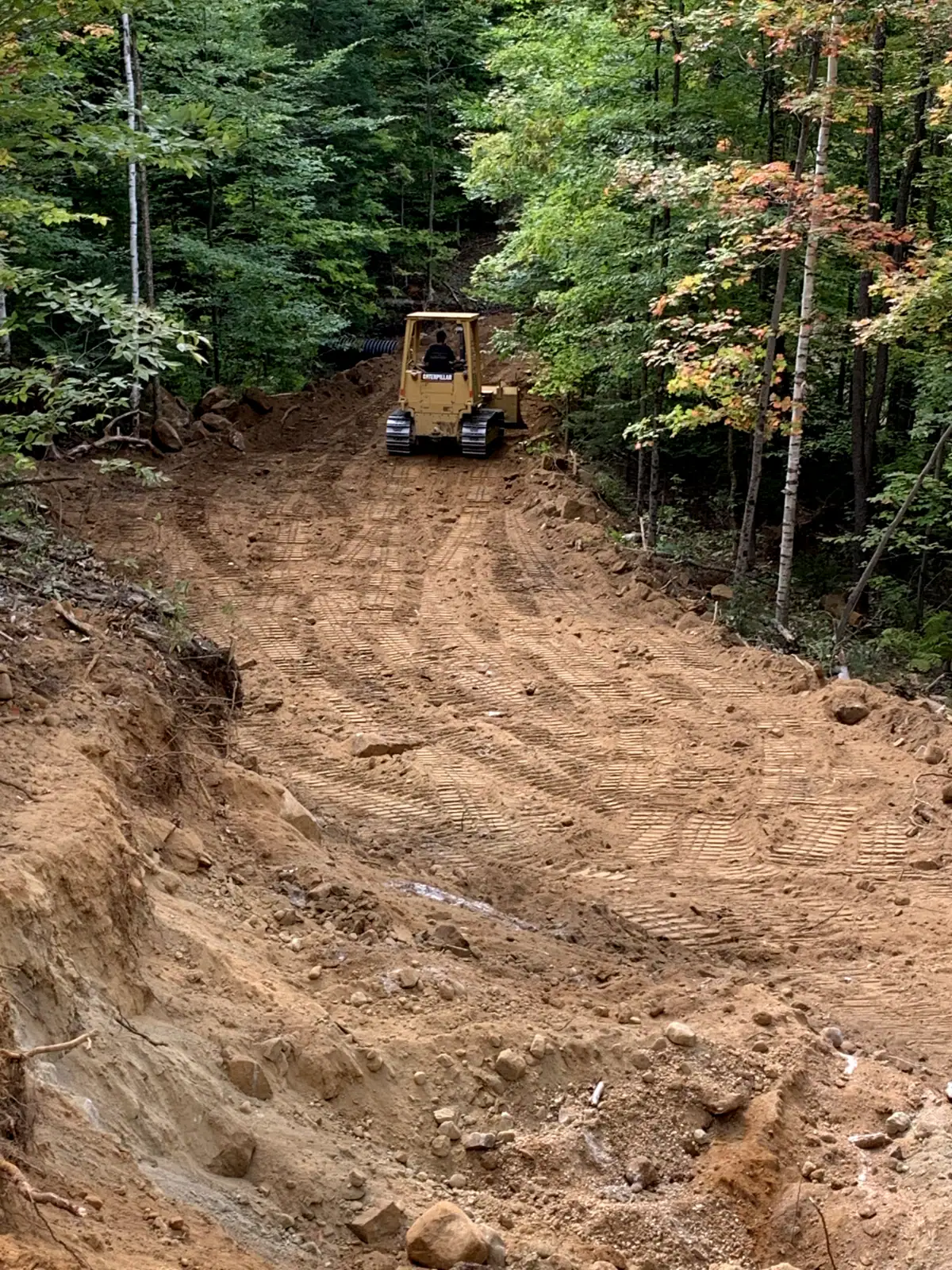
The biggest variable in French drain pricing is scope. A simple curtain drain to redirect surface water from one side of a yard is a very different project from a full perimeter foundation drain with a sump pump connection. Length of the system, depth of excavation, soil conditions, accessibility, and the discharge point all affect what the job actually costs.
What should concern you more than the price is what’s included. A properly installed French drain requires perforated pipe wrapped in filter fabric, clean crushed stone, proper grading at a consistent slope, a solid pipe run to the discharge point, and surface restoration when the work is done. Skip any one of those steps and the system will eventually fail — usually within two to five years.
A contractor who quotes you half of what everyone else quoted didn’t find a more efficient way to do the job. They cut something. Maybe the fabric, maybe the depth, maybe the pipe quality. In drainage work, those shortcuts don’t show up immediately. They show up the spring after you thought the problem was solved, when your yard is flooded again and the contractor who did the work isn’t returning your calls.
We give straightforward quotes that reflect what the job actually requires. No hidden fees, no change orders for “unexpected” conditions that any experienced excavator would have anticipated. If the scope changes, we tell you before we dig — not after.
If you already have a French drain that’s stopped working, the problem usually comes down to one of a handful of causes. Sediment and silt buildup inside the pipe is the most common — over time, fine soil particles work their way through degraded fabric or past poorly wrapped gravel and start to accumulate. Root intrusion is another frequent culprit, especially in yards with mature trees. Corrugated plastic pipe, which is cheaper than PVC and used in a lot of budget installations, is particularly vulnerable to root infiltration and can collapse under soil pressure over time.
In parts of Warren County, there’s an additional factor worth knowing about: iron ochre. It’s a reddish-orange substance produced by bacteria in iron-rich soils, and it’s documented in the Adirondack and Capital Region area. Iron ochre can accumulate inside drainage pipes and clog them in ways that look like sediment buildup but don’t respond to standard flushing. If your French drain is backing up and you’ve ruled out the usual causes, it’s worth having someone who knows the local soil chemistry take a look.
A blocked discharge point is another thing to check before assuming the pipe itself has failed. If the outlet end of the drain is buried under debris, frozen, or submerged in standing water, the whole system backs up even if the pipe is perfectly clean. This is a quick visual check you can do yourself — clear the outlet, make sure it has a clean path to drain, and see if the system recovers.
When the drain is backing up because of improper original slope, collapsed pipe, or a discharge point that was poorly designed from the start, the fix usually involves digging. That’s not a pleasant answer, but it’s an honest one. A drain that was installed wrong the first time can’t be corrected with a drain snake. If you’re in Warren County and dealing with a system that’s failing — whether we installed it or someone else did — call or text us and we’ll take a look.
Backyard flooding in this part of New York isn’t just an inconvenience — the spring snowmelt, the Adirondack clay, the frost depth — it’s a real problem that gets more expensive the longer it goes unaddressed. A properly installed French drain solves it for two decades or more. A poorly installed one gives you a false sense of security until the next wet spring proves otherwise.
What we do at Emerson Excavating and Trucking is straightforward: Josh is on-site on almost every job, the work is done to the depth and standard this climate actually demands, and the price you’re quoted is the price you pay. We’ve been working Warren County terrain long enough to know where the surprises are — and how to avoid them.
If your yard is flooding, your foundation is taking on water, or you have a drain that’s stopped doing its job, reach out to us directly. A quick call or text is the fastest way to get a real answer.
Article details:
Share:
Continue learning: