Water doesn't announce itself before it damages your foundation. Here's what Warren County homeowners need to know about French drains and why they work in our region.
Share:
Summary:
Every spring in Warren County, the same thing happens. The snowpack melts, the ground is still half-frozen, and all that water has nowhere to go — so it finds your foundation. Maybe you’ve noticed damp spots on the basement floor. Maybe there’s a smell that wasn’t there before. Maybe you’ve already seen the cracks starting.
A French drain around your house is one of the most reliable ways to stop that cycle before it becomes a structural problem. We’ll walk you through how it works, what the installation process actually involves, and what Warren County homeowners specifically need to know before you start.
A French drain is a gravel-filled trench with a perforated pipe at the bottom. Water seeps into the gravel, flows into the pipe, and gets carried away from your home to a safe outlet — a dry well, a lower area of the yard, or a storm drainage system. It sounds simple, and the concept is. But the execution is where most installations either succeed or fail.
The goal is to intercept groundwater before it reaches your foundation walls and builds hydrostatic pressure — the force that causes cracking, bowing, and seepage. Water is responsible for over 90% of foundation damage in residential homes. That’s why foundation drainage deserves to be treated as a structural investment, not a landscaping afterthought.
Here’s where a lot of homeowners get misled by the guides they find online. Most DIY resources describe a French drain as an 18-to-24-inch-deep trench — and for basic yard drainage, that’s fine. But a French drain designed to protect your foundation is a different project entirely. That trench needs to reach the depth of your footing, which on most homes means 6 to 8 feet down. You’re not redirecting surface runoff. You’re relieving pressure against the structural base of your house.
In Warren County, there’s an additional factor that most national guides completely ignore: frost depth. The frost line in the Adirondack region can reach 36 to 48 inches — well below what a standard residential drain is typically installed at. A French drain that sits above the frost line will freeze every winter, blocking flow right when spring melt begins and you need it most. That’s not a design flaw you’ll notice until the third or fourth season, and by then the damage is already underway.
The other details matter just as much. The trench needs to be lined with geotextile filter fabric before any gravel goes in — this is what prevents soil from migrating into the system and clogging it over time. The gravel should be three-quarter-inch washed crushed stone, not pea gravel, which compacts and loses its drainage capacity. The pipe — four-inch perforated PVC or HDPE — needs to be placed with the holes facing down, so it’s drawing from the gravel bed beneath it rather than collecting surface water from above. And the whole system needs a consistent slope of at least one percent throughout, or water will sit in the pipe instead of flowing out.
Skip any one of those steps and you’re not installing a French drain. You’re digging an expensive trench that will cause problems in a few years.
A French drain handles subsurface groundwater. But if your gutters are dumping water against your foundation, or your yard is graded toward the house instead of away from it, the French drain is fighting an uphill battle — literally. Effective drainage around a home is a system, not a single solution.
Proper grading is the first line of defense. The ground around your foundation should slope away from the house — a drop of roughly one inch per foot for the first six feet. When that grade is wrong, surface water from rain and snowmelt flows directly toward the foundation wall instead of away from it. We see this constantly on Warren County properties, especially older homes where the original grading has settled or been disrupted over the years.
Downspout management is the other piece most homeowners overlook. A single downspout can discharge hundreds of gallons of water against your foundation during a heavy storm. Extensions that carry that water at least six feet from the house — and ideally connect to a drainage outlet — take a significant load off your French drain and your foundation.
When all three elements work together — proper grading, managed downspouts, and a correctly installed French drain — you have a drainage system that handles what Warren County throws at it: the heavy spring melt, the summer thunderstorms that come off the Adirondacks fast and drop a lot of rain in a short window, and the freeze-thaw cycles that put stress on everything from October through April. Getting one piece right and ignoring the others is how homeowners end up calling a foundation repair contractor instead of a drainage contractor.
Want live answers?
Connect with a Emerson Excavating and Trucking expert for fast, friendly support.
Warren County isn’t generic terrain. The soils here are largely glacially deposited — a mix of clay, sandy loam, and rocky substrate left behind by the last ice age. Clay-heavy areas, which are common at lower elevations and near waterways like the Hudson River corridor, hold water instead of letting it percolate. That means groundwater moves laterally through the soil and collects against your foundation rather than draining straight down.
Understanding how the clay behaves — and where the water wants to go on a specific property — is what separates a drainage system that works from one that looks right on paper but doesn’t perform. That kind of knowledge comes from working this terrain, not reading about it.
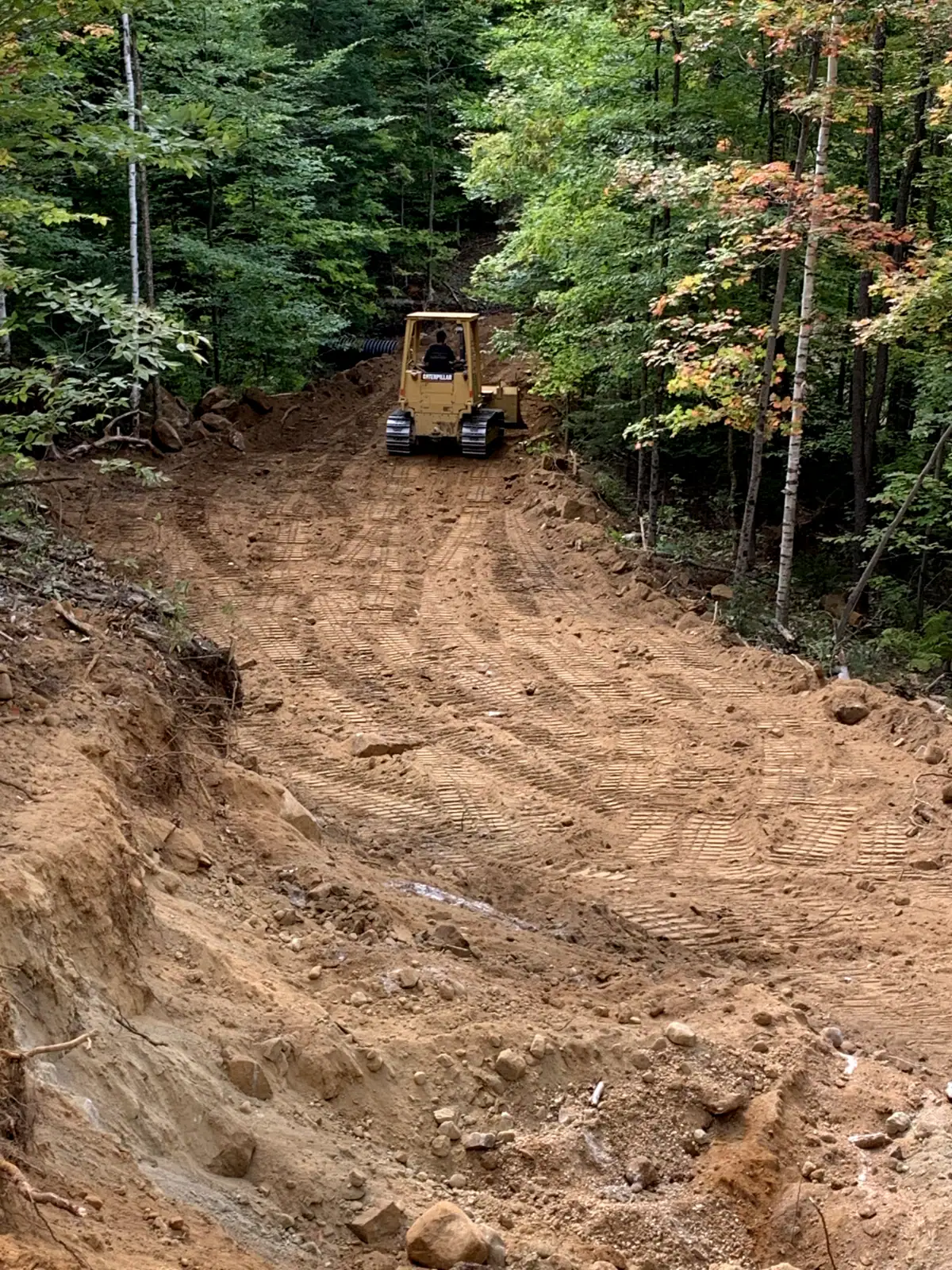
The Lake George area averages 60 to 80 inches of snowfall in a typical winter. When that snowpack melts in March and April, the ground is often still frozen several feet down, which means the meltwater can’t percolate — it just runs. Add spring rainfall on top of that, and you have a significant volume of water moving across the surface and collecting around anything that gets in its way, including your foundation.
This is the season when Warren County homeowners discover their drainage problems. The basement floor that was dry all summer suddenly has wet spots. The musty smell shows up. The sump pump runs constantly. These aren’t random events — they’re predictable consequences of inadequate drainage meeting a predictable annual water event.
A properly installed French drain intercepts that water before it reaches the foundation wall and carries it away. But the system has to be designed for local conditions — the frost depth, the clay behavior, the volume of spring melt — not for a generic residential property in a warmer climate. That’s why installation depth matters so much here. A drain that sits above the frost line will be frozen solid in February and March, exactly when you need it working.
For properties in communities like Warrensburg, Queensbury, Thurman, or Bolton Landing, the terrain adds another variable: slope. Many Warren County homes sit on hillsides or near stream valleys, which means groundwater is actively moving toward the foundation from uphill. In those cases, a curtain drain — installed upslope to intercept groundwater before it reaches the house — may be part of the solution alongside a perimeter foundation drain. The right answer depends on the specific property, and that’s a conversation worth having before any digging starts.
A professional French drain installation runs between $500 and $18,000 depending on the size and complexity of the system. For a straightforward perimeter drain on a typical residential property, most homeowners are looking at something in the middle of that range.
Foundation repair is a different conversation. Minor crack repairs run $250 to $800 per crack. If the damage has progressed to the point where hydraulic piers are needed to stabilize or lift a settling foundation, you’re looking at $20,000 or more. Mold remediation — a common downstream consequence of unaddressed water intrusion — adds another $1,500 to $6,000 on top of that.
The comparison is meant to put the cost of a French drain in the right frame. This is a long-term infrastructure investment in your home — one that, when installed correctly, lasts 30 to 40 years. Nearly 98% of basements experience water problems at some point. That’s a statistic about what happens when drainage isn’t treated as a priority.
For homeowners building new in Queensbury or elsewhere in Warren County, there’s an even stronger case for installing French drains during site prep, before the foundation is poured. Retrofitting drainage around an existing foundation requires excavating next to the structure, which is more involved and more expensive than installing the system before the house goes up. If you’re in the planning stages of a new build, this is the right time to have that conversation.
A French drain done right is a long-term solution. Done wrong — wrong depth, wrong slope, wrong materials, no fabric — it’s an expensive problem that takes a few seasons to reveal itself. The difference almost always comes down to who installs it and whether they actually understand the conditions on your specific property.
Warren County’s clay soils, frost depth, and spring snowmelt aren’t details you learn from a national installation guide. They’re details you learn from working this terrain for years.
We’re based in Corinth, right at the Saratoga-Warren County line, and we’ve been working this ground since 1997. Josh is on almost every job — not a foreman, not a crew lead, but the owner. If you’re dealing with a wet basement, standing water, or you’re planning a new build and want to get the drainage right from the start, give us a call or send a text. We’ll take a look at what you’re working with and give you a straight answer.
Article details:
Share:
Continue learning: