Standing water, soggy lawns, and foundation concerns all point to the same problem — but not the same fix. Here's how to tell which drainage system you actually need.
Share:
Summary:
Water problems in your yard rarely announce themselves clearly. Sometimes it’s a soggy patch that never dries out. Sometimes it’s water creeping toward your foundation after every heavy rain. Sometimes it’s a backyard that becomes unusable for weeks every spring once the snow starts melting off. Whatever it looks like on your property, the underlying question is the same: what kind of drainage system do you actually need — and will it work?
There’s no one-size-fits-all answer. The right system depends on your soil, your slope, where the water is coming from, and where it needs to go. Here’s what you need to know before making any decisions.
Most drainage problems fall into a few categories: water pooling on the surface, water moving too fast across a slope, water saturating the soil near your foundation, or stormwater coming off your roof and hardscape with nowhere to go. Each of those problems has a different solution.
Surface drains and catch basins collect standing water at low points and channel it away through underground pipe. French drains intercept groundwater or subsurface flow and redirect it before it reaches structures. Regrading changes the slope of the land itself so water naturally flows away from where you don’t want it. And dry creek beds or swales manage surface runoff in a way that’s functional and, when done right, actually looks good.
Understanding which category your problem falls into is the starting point. Skipping that step — and jumping straight to installing a French drain because you’ve heard of them — is how homeowners end up spending money on a system that doesn’t address what’s actually happening on their property.
A lawn drainage system is specifically concerned with managing water in a way that keeps your grass healthy and your yard usable — without turning the whole thing into a construction zone. That distinction matters more than people realize.
French drains are one of the most commonly installed solutions for lawns with chronic saturation. A trench is dug, lined with filter fabric, filled with drainage aggregate, and fitted with a perforated pipe that carries water away from the problem area toward a proper outlet. Done correctly, a French drain is nearly invisible once the lawn grows back — and it lasts 30 to 40 years. Done incorrectly — wrong slope, missing filter fabric, poor outlet placement — it clogs within a few years and the problem returns, often worse.
Catch basins are another option worth understanding. These are essentially underground collection boxes with a grated surface opening, installed at low points where water consistently pools. They connect to a pipe that carries captured water away from the yard. They’re particularly useful in areas where surface water has nowhere to go on its own — flat yards, spots at the base of a slope, or areas where downspouts dump water directly onto the lawn.
Regrading is the option that often gets overlooked because it doesn’t involve pipe or hardware — just earth. If your yard’s slope is directing water toward your house rather than away from it, or if a low spot has developed over time from soil settling, regrading the surface can solve the problem at its source. It’s not always the flashiest solution, but it’s frequently the most durable and cost-effective one when the geometry of the land is the real issue.
The right choice between these depends on whether your problem is surface water, subsurface saturation, or a grading issue — and often it’s a combination of more than one.
Backyard drainage issues tend to be more complicated than front yard problems, and for a few specific reasons. Backyards are often lower-lying, more enclosed, and more likely to receive water from multiple directions — your own roof, neighboring lots, and natural slope all contributing to the same low point behind your house.
In Warren County, this gets compounded by a few local realities. The clay-heavy soils throughout the region don’t drain quickly. Water moves through clay slowly, which means the ground stays saturated longer after a rain event — and dramatically longer after the spring snowmelt. If you’ve watched your backyard hold standing water well into May while your neighbors with sandier soil have dried out, that’s clay behavior. It’s not unusual here, but it does mean standard drainage approaches need to account for how slowly water actually moves through the ground.
Sloped backyards in the hillier parts of Warren County — moving north and west toward the Adirondacks — face a different challenge. Water moves fast down a slope, and without a proper interceptor drain or swale to redirect it, it picks up speed and volume before hitting structures, fences, or neighboring properties. A curtain drain — essentially a French drain installed horizontally across a slope to intercept water before it reaches a problem area — is often the right tool for these situations.
For flat backyards in Glens Falls or Queensbury neighborhoods, the issue is usually that water has nowhere to go. The yard is level, the soil is slow to absorb, and every rain event leaves a shallow lake that takes days to disappear. Here, a combination of catch basins, underground pipe, and a clear discharge point to a storm drain or daylight outlet is typically the most effective approach.
The honest answer is that no one can tell you with certainty which system your backyard needs without standing on the property, looking at the slope, digging into the soil, and tracing where the water is actually coming from. Anyone who quotes you a drainage solution over the phone without a site visit is guessing.
Want live answers?
Connect with a Emerson Excavating and Trucking expert for fast, friendly support.
Rain drainage systems focus specifically on managing stormwater and surface runoff — the water that comes off your roof, your driveway, your patio, and any other impervious surface on your property. This is a distinct problem from groundwater saturation, and it calls for a different set of tools.
When rain hits your roof, it has to go somewhere. If your downspouts are dumping that water directly against your foundation or onto a flat section of lawn, you’re concentrating a significant volume of water in a place that can’t handle it. Channel drains, downspout extensions, and underground pipe systems that carry roof runoff away from structures are all part of how a rain drainage system works.
The distinction matters because homeowners often try to solve a stormwater problem with a groundwater solution — installing a French drain, for example, when the real issue is that their downspouts are discharging eight feet from their foundation with nowhere to go.
If you’ve lived in Warren County, NY for at least one full winter, you already understand what happens in March and April. The snowpack that’s been accumulating since November starts releasing all at once — and it releases fast. A yard that handled every rain event in October without issue can be completely overwhelmed by snowmelt because the volume is simply in a different category.
This is one of the most common triggers for drainage calls in this area, and it’s also one of the most preventable problems. Properties that have a properly designed rain drainage system — one that accounts for peak snowmelt volume, not just average rainfall — handle spring without incident. Properties that don’t end up with standing water, saturated soil against their foundation, and mud season that lasts well into late spring.
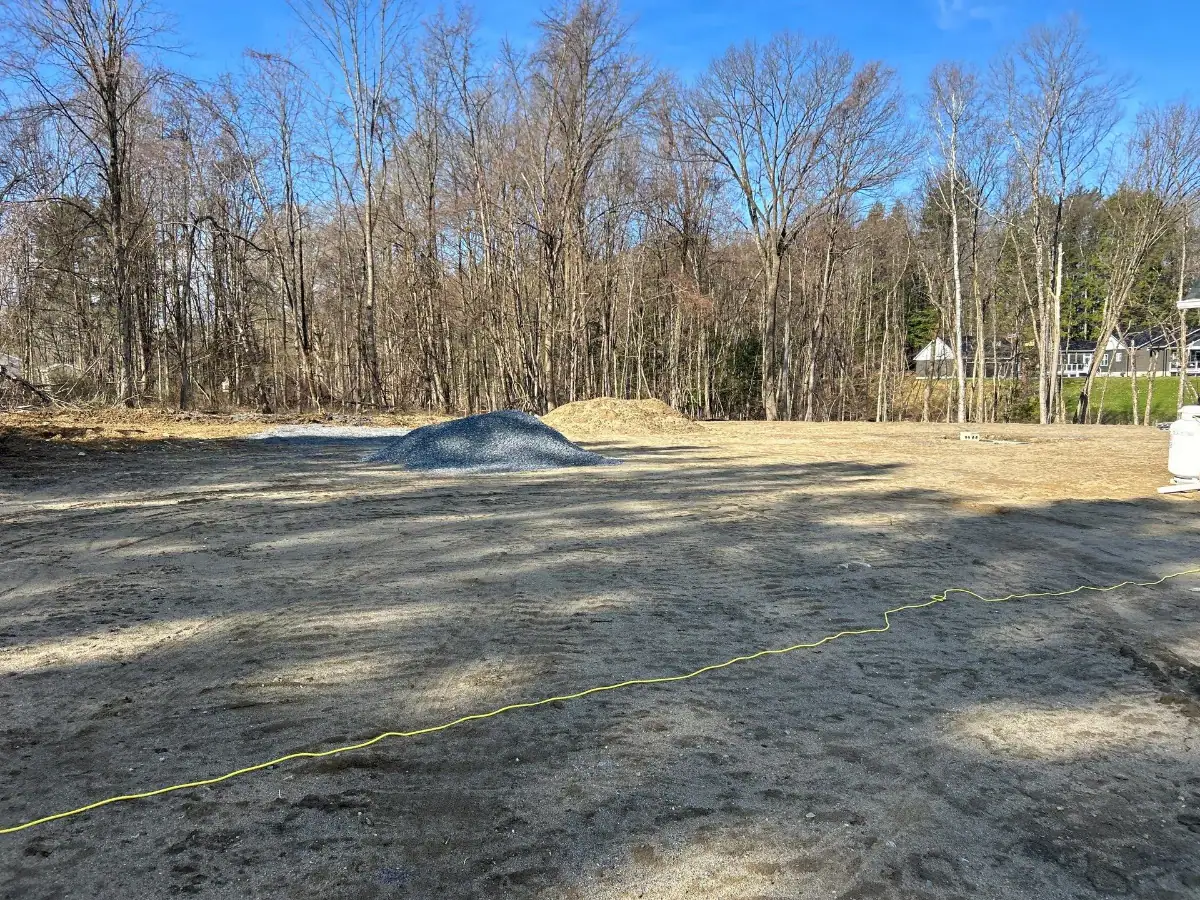
For new construction in Queensbury and the surrounding areas, this is particularly worth thinking about before the landscaping goes in. Installing underground drainage during site prep — before the lawn is established, before the hardscape is in place — costs significantly less than retrofitting it later. Excavating through a finished lawn and landscaping to install pipe adds time, material, and restoration costs that compound quickly. Getting the drainage right during construction is one of those decisions that pays for itself the first spring after you move in.
Downspout drainage is also worth addressing directly. A single downspout can discharge several hundred gallons of water during a significant storm event. If that water is landing within a few feet of your foundation and the soil is already saturated from snowmelt, you’re stacking two problems on top of each other. Extending downspouts underground and directing them to a proper daylight outlet away from the house is a straightforward fix that prevents a disproportionate amount of damage.
This is the part most drainage content glosses over, but it’s probably the most useful thing to understand before you hire anyone.
A French drain installed without filter fabric — the geotextile liner that wraps the gravel and pipe — will clog with fine soil particles within a few years. The pipe fills, water backs up, and the system stops working. It’s one of the most common corners that gets cut on cheap installations, and it’s invisible from the surface until the drain fails.
Slope is another variable that separates a functional system from one that doesn’t work. French drains require a consistent 1 to 2 percent grade to move water by gravity. That sounds simple, but calculating and maintaining that slope across a trench that might run 100 feet or more through uneven ground requires precision. An improperly sloped drain doesn’t just underperform — it can actually hold water in the trench itself, creating exactly the kind of saturated soil condition you were trying to eliminate.
Outlet placement is the third common failure point. Every drainage system needs somewhere to discharge the water it collects. If that outlet gets blocked, backfilled, or installed in a location that floods during the same rain events the system is supposed to manage, the whole system is compromised. A proper outlet — whether that’s a daylight discharge point, a connection to a storm drain, or a dry well — needs to be sized correctly and kept clear.
We’ve assessed properties throughout Warren County where a previous drainage attempt made the problem worse rather than better. Not because the homeowner made a bad decision, but because the installation skipped steps that aren’t visible once the trench is backfilled. The difference between a system that lasts 30 years and one that fails in three is almost entirely in those details — the materials used, the slope maintained, and the outlet designed correctly from the start.
The core takeaway from all of this is straightforward: the right drainage system depends on your specific property — your soil, your slope, your water source, and your goals. There’s no universal answer, and anyone who tells you otherwise before seeing your yard isn’t giving you useful information.
What we do know is that getting it right the first time is almost always cheaper than fixing a failed system later. That’s true whether you’re dealing with a soggy backyard in Glens Falls, a sloped lot in Queensbury, or a new home build anywhere in Warren County where the natural drainage patterns have been disrupted by construction.
If you’re trying to figure out which system you actually need — or whether a previous fix is working the way it should — we’re worth a call. We’ve been working this ground for a long time, and we’re happy to take a look before recommending anything.
Article details:
Share:
Continue learning: